
Ludwig Mies van der Rohe (1886-1969) has long been considered one of the most important architects of the 20th century, and his significance to the field of modern architecture is beyond dispute. In Europe, before World War II,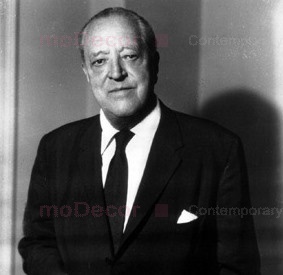 Mies emerged as one of the most innovative leaders of the modern movement, producing visionary projects for glass and steel and executing a number of small but critically significant buildings. In the United States, after 1938, he transformed the architectonic expression of the steel frame in American architecture and left a nearly unmatched legacy of teaching and building.
Mies began his career in Europe, becoming one of the pivotal leaders of the architectural avant-garde by the early 1920s. Born in 1886 in Aachen, Germany, Mies van der Rohe had his most important early apprenticeship in the offices of Peter Behrens between 1908 and 1911. After World War I, Mies joined the utopian artists of the Novembergruppe and founded the avant-garde magazine G (Gestaltung). Around 1920, Mies designed several projects for glass skyscrapers in central Berlin, in crystalline, vertical facets of glass and suspended floor planes, just as German expressionists such as Bruno Taut and Hugo Häring were calling for a revolutionary architecture of transparency and organicism.
After 1923, Mies’s style shifted, and he came heavily under the influence of Dutch neo-plasticism and Russian suprematism. The former influence, along with the work of Frank Lloyd Wright, drove Mies to experiment with independent walls and ceilings arranged in an open, pin-wheeling manner. The latter influence drove Mies to consider the reduction and abstraction of these elements into dynamic and contrapuntal compositions of pure shapes in space.
These experiments culminated in one of Mies van der Rohe’s most significant works, the German Pavilion built for the Barcelona World Exposition in 1929. Commonly known as the Barcelona Pavilion, this small, temporary structure, has been reconstructed, and remained one of the most recognized objects in the architectural history of modernism. Composed mainly of a raised terrace and a simple rectangular structure with eight cruciform columns, it set an important precedent for the Farnsworth House.
In 1930, Mies succeeded Hannes Meyer as director of the Dessau Bauhaus, remaining in that position until the Bauhaus was forcibly closed by the National Socialist government in 1933. After his arrival in the United States in 1937, Mies van der Rohe went on to significantly change the American architectural landscape, particularly during the rebuilding that immediately followed World War II.
he accepted a position as head of the architecture department at the Armour Institute of Technology, soon to be renamed the Illinois Institute of Technology. At his inaugural lecture as director of the department in 1938, Mies stated:
“In its simplest form architecture is rooted in entirely functional considerations, but it can reach up through all degrees of value to the highest sphere of spiritual existence into the realm of pure art.”
This sentence summarized what had become Mies van der Rohe’s consistent approach to design: to begin with functional considerations of structure and materials, then to refine the detailing and expression of those materials until they transcended their technical origins to become a pure art of structure and space.
In 1939, he began preliminary designs for the campus of Illinois Institute of Technology on the south side of Chicago. Its composition of low-slung rectangular buildings, arranged as subtly juxtaposed figures on a cleared urban site would constitute one of the most important examples of modernist urban design. In 1946, Mies would begin his work on the Farnsworth house, in which he was able, as in the Barcelona Pavilion, to pursue his ideas of structure and space, with minimal requirements of program. After World War II, Mies would become perhaps the most significant designers of American skyscrapers, transforming the common steel frames of such structures into subtle expressions of module, proportion and detail. Buildings such as 860-880 Lake Shore Drive in Chicago (1949-51) and the Seagram Building in New York (1958) have become canonical monuments of modernism and are studied by scholars and architects all over the world.

i never write remarks on articles, but your blog post encouraged me to comment on your writings. Thank you for the info, I will tweet your post.
What’s Taking place i am new to this, I stumbled upon this I’ve discovered It absolutely useful and it has helped me out loads. I’m hoping to contribute & aid other customers like its aided me. Great job.